


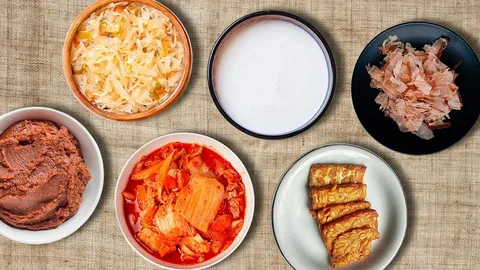
There is no human culture that did not ferment food. From the earliest archaeological evidence of intentional fermentation in Neolithic China to the living traditions of every continent, the transformation of raw ingredients through microbial activity has been a constant in the human food story. Fermentation was not invented in a laboratory. It was discovered through observation, repeated across generations, and refined into regional traditions that shaped cuisine, agriculture, and health practices across the entire span of human history.
Understanding traditional fermented foods as cultural artifacts, and not just as trendy health products, provides context for why these preparations matter and what their preservation represents.
East Asia: The World’s Richest Fermentation Tradition
The fermentation traditions of China, Japan, Korea, and Southeast Asia represent the most diverse and sophisticated body of fermentation knowledge on earth. Soy fermentation alone produced dozens of distinct products across the region: miso, soy sauce, tempeh, natto, doenjang, ganjang, and regional variations of each across different climates and cultures. Each represents a distinct microbial ecology and a distinct nutritional and culinary profile.
Korean kimchi is perhaps the most globally recognized traditional fermented vegetable, but it represents only one strand of a fermentation tradition that encompasses hundreds of fermented preparations using every available ingredient. The underlying principle of fermentation that produces kimchi, vegetables packed with salt to create a self-brine, colonized by lactic acid bacteria, transformed over days and weeks, is identical to the principle that produces German sauerkraut, Slavic brine pickles, and West African fermented locust bean condiments. The convergent evolution of this technique across disconnected cultures reflects its power and accessibility.
European Traditions
European fermentation traditions are defined most visibly by their dairy and vegetable ferments. The cheesemaking traditions of France, Italy, Switzerland, and the UK represent some of the most technically sophisticated fermentation knowledge ever developed. A properly aged Parmigiano-Reggiano, a washed-rind French munster, or a traditional English stilton is the product of a specific microbial ecology that has been maintained and refined over centuries.
Sourdough breadmaking, the fermentation of grain dough by wild yeast and lactic acid bacteria, predates commercial yeast by thousands of years. The diversity of regional sourdough traditions, each reflecting the local microbial community and the local grain, represents an irreplaceable body of biodiversity. The shift to commercial yeast in the 20th century produced standardized, efficient bread but erased most of that diversity from active practice.
African Fermentation Traditions
African fermentation traditions are among the most diverse in the world and among the least studied by Western food science. Injera, the fermented teff flatbread of Ethiopia and Eritrea, is produced by a three-day fermentation of teff flour that develops a complex sour flavor and a distinctive spongy texture through bacterial and yeast activity. Ogi and akamu, fermented cereal porridges widely consumed across West and Central Africa, represent essential weaning foods and everyday nutrition for large populations. Dawadawa, fermented locust bean seeds used as a condiment across the Sahel and West Africa, provides concentrated protein and umami flavor through fungal and bacterial fermentation.
South Asian Fermentation
The fermentation traditions of South Asia are woven into the fabric of daily cuisine. Idli and dosa, the fermented rice and lentil preparations of South India, are produced by overnight fermentation that increases protein digestibility, synthesizes B vitamins, and produces the characteristic light, sour flavor. The fermented rice batter requires no added culture: the bacteria and yeasts present on the grain and lentils initiate fermentation naturally. This is precisely the principle of all traditional lacto-fermentation, using the microbial community naturally present on and in food rather than commercial starter cultures.
Indigenous American Fermentation
Indigenous fermentation traditions in the Americas are extensive and often underrecognized. Chicha, the fermented maize beverage of Andean cultures, was both a ceremonial drink and a daily caloric resource for large populations. Traditional chocolate fermentation, the microbiologically essential step in converting cacao beans into the chocolate flavor precursors we recognize, was developed by Mesoamerican cultures over centuries of practice. Pozol, a fermented maize beverage from Mexico, contains dozens of microbial species and provides meaningful nutrition beyond simple caloric content.
What Traditional Fermentation Tells Us
Every traditional fermentation practice reflects the same fundamental insight: that microbial activity can be directed through simple environmental management to transform raw ingredients into more stable, more nutritious, and often more delicious products. Salt, time, temperature, and the naturally present microbial community are the inputs. The outputs are preserved food, synthesized nutrients, enhanced bioavailability, and probiotic organisms.
The global convergence on similar fermentation techniques by cultures with no contact with each other is evidence that this is not arcane knowledge. It is applied biology that any careful observer with simple ingredients can access. The resurgence of interest in traditional fermentation in the contemporary food world is not nostalgia. It is the recovery of a practical knowledge base that modernity very nearly discarded.