


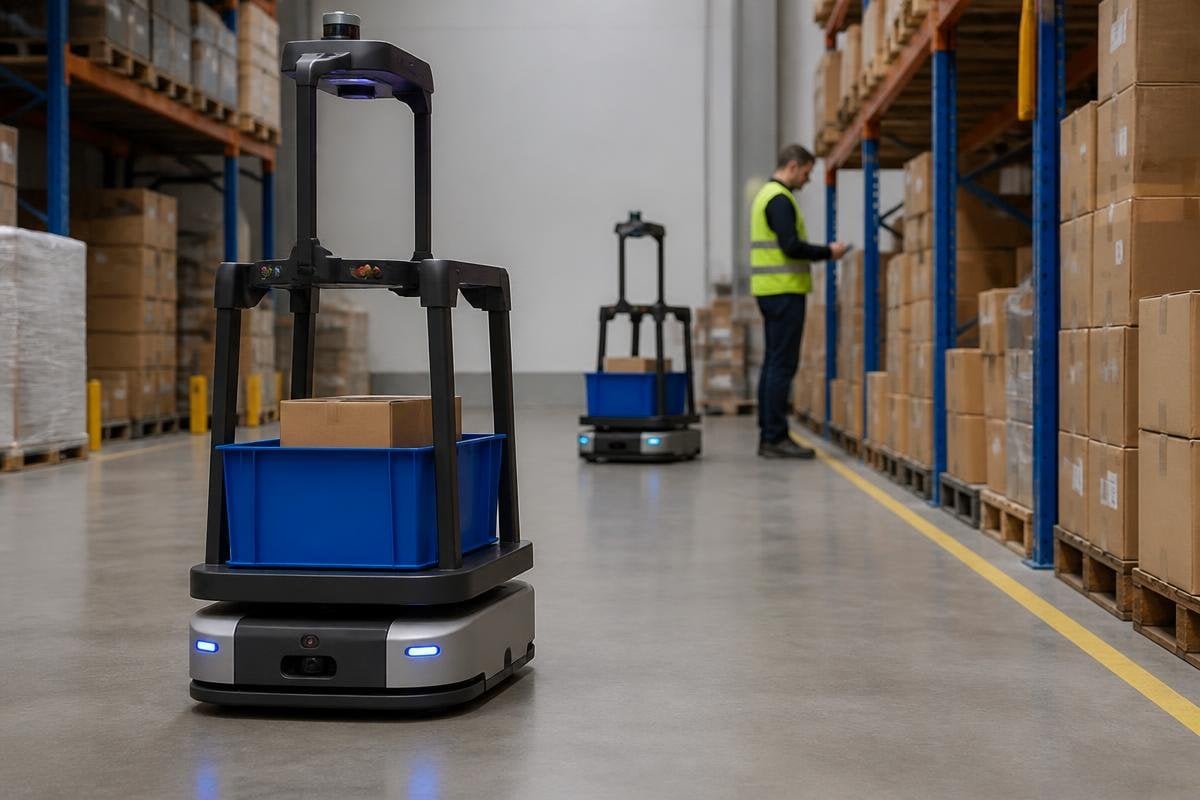
A warehouse gives robots repeatable tasks, fixed routes, and clear measures such as items picked or pallets moved. That makes it a useful place to check whether an autonomous system works outside a lab.
Quick read
- Repeated routes give mobile robots the same task many times.
- Barcode scans and warehouse software make each action easier to check.
- People, forklifts, dust, and changing stock expose limits that lab tests can miss.
The work is easy to measure
Most warehouse tasks have a clear start and finish. An autonomous mobile robot (AMR) can collect a tote, follow a mapped route, stop at a work area, and return for another load.
That path creates useful records. The warehouse management system can show when the task began, when the item arrived, and whether the scan matched the order. A manager can then compare robot runs with the existing process without relying on a broad claim about performance.
The same logic applies to robotic arms. A vision system finds a box, the arm closes its gripper, and a scanner checks the item before it moves on. If the box falls or the barcode fails, the system has a clear error to record.
Warehouses add the problems labs remove
A lab can give a robot clean floors, open space, and one object at a time. A working warehouse adds people crossing routes, forklifts reversing near corners, wrapped pallets, changing light, and stock placed a little outside its expected position.
Those details matter because sensors work from physical signals. LiDAR measures distance with laser pulses, while cameras depend on light and a clear view. Dust on a lens, a reflective package, or a blocked aisle can change what the robot sees.
The robot also has to share space with people. Its software must slow down, stop, and restart without sending workers into an unsafe path. A stop that happens too often can reduce output. A stop that happens too late creates a safety problem.
Software gets tested with the hardware
Warehouse robots rarely work alone. An AMR may receive a task from a warehouse management system, send its location to a fleet manager, and wait for a conveyor or robotic arm to finish its part of the job.
That connection is where many trials become useful. The robot may move well, yet lose time when a door stays closed or a conveyor reports the wrong state. A warehouse test checks the full chain, including the messages between systems.
Warehouse tests need more than a robot video. Reporting from Robot24 can put a named site, task result, and handoff beside the machine’s headline claim. That record leads to the next problem: data can fail even when the route looks clear.
A trial can also expose data problems. A barcode may be readable to a person but fail under the robot’s camera. A map may show an open route while a parked pallet blocks it. Each fault points to a change in the robot, the warehouse layout, or the software link.
The limits of a warehouse trial
A warehouse can test repeated work well, but it can’t answer every question. A robot that moves cartons inside one building may need new maps, safety checks, and charging plans at another site.
The results also depend on the task. A robot built for flat floors and tote transport may say little about stairs, outdoor ground, heavy loads, or loose objects. A trial needs a clear record of the floor, payload, route length, shift pattern, and human traffic.
Cost matters too. The robot is only one part of the system.
A site may need charging points, network work, safety barriers, software links, staff training, and service support. If those items stay outside the trial budget, the final result can look better than the full deployment would be.
A practical check before a pilot
Use these questions before putting a robot into a live warehouse:
- Name the task: Can the team state the load, route, handoff, and finish point?
- Set the measure: Will the trial record cycle time, error rate, stops, and human interventions?
- Map the site: Have the team checked doors, ramps, floor changes, blind corners, and shared paths?
- Check the link: Can the robot exchange tasks and status with the warehouse software?
- Price the whole job: Do the figures include power, network work, safety changes, training, and service?
- Set a stop rule: What result ends the trial, changes the design, or sends the team back to manual work?
I’d choose a warehouse for a robotics trial when the task is repeatable and the site can record failures without hiding them. That turns the building into a controlled test site, while the people and equipment inside keep the test honest.
The next useful question is concrete: after the trial, can the robot complete the same task for a full shift with recorded stops, errors, and support costs?