


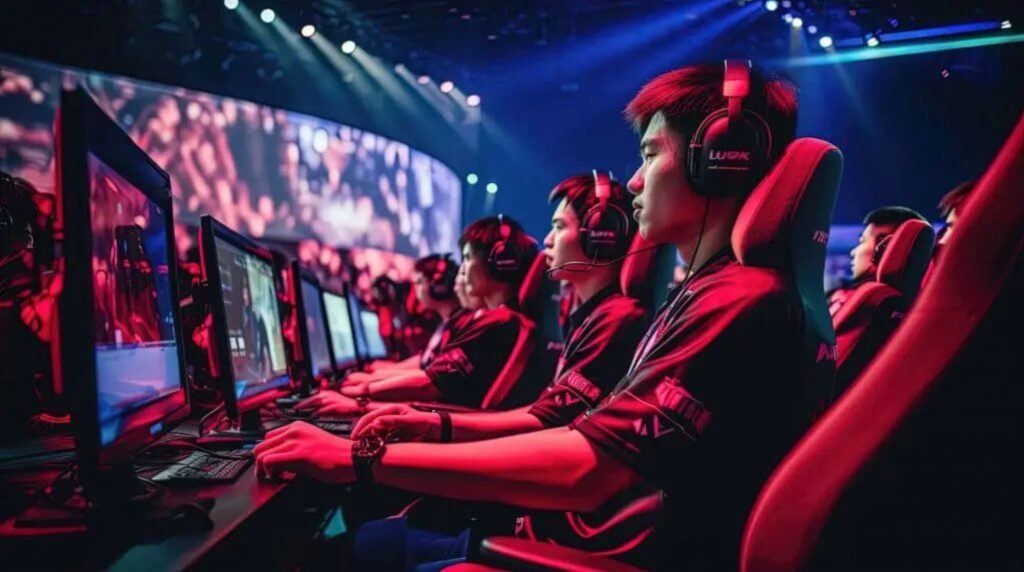
Walk into a packed E-Sports arena during a major tournament and the energy is hard to miss. Thousands of fans screaming, lights flashing on giant screens, commentators calling every move with the fury of a championship final, and players sitting in full lock-in, reacting in milliseconds. The modern E-Sports industry can be a real surprise for those who still think of gaming as a casual hobby that can be done alone in a bedroom.
What’s interesting about E-Sports is not just the size of the audience, but the speed with which it went from a niche online culture to a global entertainment business. Today, competitive gaming has sponsorship deals, celebrity investors, streaming contracts, university scholarships, and fan communities as passionate and loyal as traditional sports.
What’s interesting is that this growth didn’t occur because companies forced it to be there. It grew because millions of people were already organically watching, playing, streaming and building communities around games. Businesses just saw there was a huge audience watching. E-Sports today is a far cry from the sidelines of mainstream entertainment. In many ways it already crossed that line.
Why E-Sports Became a Global Phenomenon
The rise of E-Sports is a symptom of a broader shift in how younger generations are consuming entertainment. Gone are the days when traditional television ruled the roost and held everyone’s attention. Instead, people are spending more time on streaming platforms, gaming communities, social media and interactive digital spaces.
E-Sports is a natural fit for that ecosystem since it’s competition, entertainment, storytelling and community all rolled into one. Fans don’t just watch games. They are players who follow players, talk strategy on the internet, watch streams, and live in the culture of gaming every day.
Thanks to streaming platforms, this growth was massively accelerated. Services like Twitch and YouTube Gaming made competitive gaming a spectator experience immediately available to audiences everywhere. You can watch a tournament in South Korea live, and talk at the same time with people in Europe and North America, and someone in Brazil can do it.
I just discovered Roots Analysis and they said “The E-Sports market size is expected to increase from USD 2.55 billion in 2024 to USD 18.85 billion by 2035, registering a CAGR of 19.95% during the forecast period 2024-2035.” Those numbers are a sign of how fast E-Sports is moving from being a subculture to becoming a big business.
What really stands out is how deeply E-Sports feels connected to the internet culture itself. It feeds off immediacy, online interaction, memes, live commentary and community participation in ways traditional sports often find difficult to replicate digitally.
The Business of Competitive Gaming
People don’t realize how big the E-Sports business ecosystem has gotten. There is no one source of revenue anymore. Sponsorships, advertising, streaming rights, merchandise sales, tournament tickets, game publisher partnerships and brand collaborations drive the market.
Big global brands that used to scoff at gaming are now spending millions on E-Sports sponsorships. Technology companies were naturally some of the first, but now even fashion brands, beverage companies, auto manufacturers and financial services firms want a piece of gaming pie. It is simple. The E-Sports audience is socially engaged, digitally savvy, and hard to reach through traditional advertising channels. Brands see gaming communities as long-term consumers.
Today, professional E-Sports organizations function more like traditional sports franchises. Teams have coaches, analysts, psychologists, nutritionists, and marketers. Some organizations have training facilities where the players can train together on regimented schedules.
Tournament prize pools have also ballooned over the years. Today, some championships have multi-million-dollar winnings, creating career options that would have sounded impossible for gamers a generation ago. One E-Sports executive described the industry as “sports born on the internet,” and honestly, that feels like one of the clearest ways to describe what it is.
Streaming Culture Changed Everything
The E-Sports market cannot be understood without the discussion of live streaming culture. Competitive gaming and streaming grew up together, feeding off each other all the time.
Fans watch not only polished tournament broadcasts. Fans watch individual streamers practice, react to games, joke with audiences and share personal moments for hours on end. It offers a feeling of connection that feels more immediate and intimate than many traditional celebrity-to-fan relationships.
Some E-Sports personalities are now global influencers with audiences bigger than TV networks. Their communities are watching not just gameplay but personalities, humour, opinions and lifestyle content. Streaming also lowered barriers for would-be players and creators. A talented or entertaining person can create an audience from home, without the need for the gatekeepers of traditional media.
But this environment is also pressurized. Many streamers and pro-gamers burn out from the pressure of always having to create content, be live, and be online for their viewers. E-Sports lifestyle may be glamorous from the outside, but behind the scenes it can be mentally exhausting. “People see the tournaments, not the ten hours of practice before them,” one former professional player once admitted. That reality is becoming a bigger conversation within the industry.”
Game Publishers Role in the Industry
E-Sports, unlike traditional sports, is heavily reliant on the game publishers, as the companies own the games themselves. That creates an interesting dynamic where publishers control the rules, tournaments, monetization systems, and sometimes even whole competitive ecosystems.
Popular E-Sports titles like League of Legends, Counter Strike, Valorant, Dota 2, and Fortnite all have different communities and competitive structures. Publishers need to support long-term competition and audience engagement for a successful E-Sports ecosystem.
Some publishers are actively investing in pro leagues and franchising models. Others have more competitive open scenes, fueled by community tournaments and third-party organizers. That level of corporate control is both stability and risk. When a publisher grows disillusioned with competitive support, an E-Sports ecosystem can shrink fast. But soccer and basketball themselves are not owned by anybody, so that issue is less of a concern for traditional sports. Still, publishers are increasingly aware that E-Sports add significant shelf life and cultural relevance to games. Competitive communities will keep players engaged for years, not months.
Challenges in the E-Sports Industry
E-Sports is growing fast, but it also has a lot of challenges that could define where the industry goes. One of the biggest concerns is financial sustainability. Some organizations spend a lot on player salaries, facilities and branding but have difficulty making consistent profits. Revenue growth has been impressive but industrywide profitability is not a given.
Another topic that is gaining more attention is player wellbeing. Intense practice schedules, pressure from the internet, criticism from the public and short career spans can have a significant impact on mental health. There’s also worry about fan and creator burnout. The internet is a fast paced place, and it can be exhausting for those involved to constantly try and hold audience attention.
Regulation and governance are still somewhat disjointed. Different games have different competitive structures, making it difficult to standardize across the broader industry. Competitive ecosystems still have issues with cheating and match integrity. “Technology and organizations need to closely monitor online environments to ensure fairness is maintained. And many of those growing pains are reminiscent of what traditional sports and entertainment industries went through in earlier phases of development.
The Future of Gaming Is More Than We Can Imagine
What’s interesting about E-Sports is that it’s increasingly crossing over with entertainment, social media, fashion, music and even education. Universities now offer E-Sports scholarships and gaming programs. Celebrities put money into E-Sports organizations. Gaming franchises work with music artists. Virtual concerts and digital fan experiences are all the time blurring the boundaries between gaming and mainstream culture.
Mobile E-Sports is also expanding rapidly, especially in areas where it’s easier to get your hands on a smartphone than a gaming computer or console. This is opening competitive gaming to whole new audiences around the world. Also, future E-Sports formats could be influenced by virtual reality and AI driven gaming experiences. Technology is changing fast, so the industry is changing fast.
One thing seems clear though. The days when E-Sports had to fight for legitimacy are long gone. The conversation has changed from “Is this happening?” to “How big can this get?”
Conclusion
E-Sports is booming, the competitive gaming scene perfectly fitting into the modern digital culture. It mixes entertainment, community, technology, streaming and global accessibility in ways that strongly resonate with younger audiences.
What started as a niche gaming competition has turned into a billion-dollar ecosystem with professional teams, global sponsors, personalities that stream the games and huge international fan bases. There are challenges for the industry to address around sustainability, player wellbeing and long-term structure but the momentum behind E-Sports is still strong.
What’s interesting about E-Sports is that it encapsulates a larger change that’s going on in entertainment as a whole. Audiences are no longer passive consumers of content. They engage, participate, stream, comment and become part of the experience in real time. It’s built for competitive gaming from day one, so it’s a natural fit for that environment.