


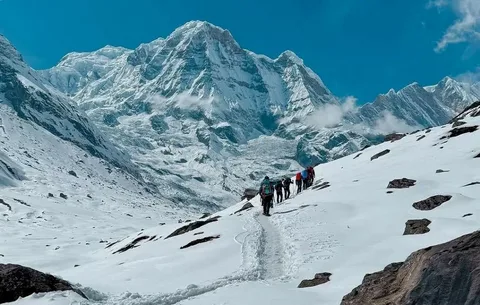
Nepal is home to many spectacular mountains that challenge every climber and mountaineer. Among those mountains, the Annapurna IV (7,525 m) in the Annapurna region challenges climbers with technical difficulties, objective hazards, and demanding conditions. Its mixed steep terrain, requirement of navigating in 65° to 70° ice slopes, rock climbing and possibility of rock falls, and constant threat of avalanches without warning make it one of the deadliest 7000 m peaks in Nepal.
While the Annapurna IV may not receive the same global attention as Everest or Annapurna I, it remains a prime objective for serious mountaineers seeking a genuine Himalayan challenge.
A Mountain of Technical Complexity
Annapurna IV is a technically complex peak that tests your technical skills in every section. Unlike some expedition peaks that rely primarily on endurance, Annapurna IV requires a high level of technical competence.
The mountain features steep snow slopes, exposed ridges, ice sections, and complex route-finding challenges. Climbers must be comfortable using crampons, ice axes, fixed ropes, and advanced mountaineering techniques in difficult conditions.
Weather and snow conditions can dramatically increase the difficulty of the route from season to season.
Demanding Altitude
At over 7,500 meters, Annapurna IV enters the realm where altitude becomes a major factor. Even highly trained climbers can experience reduced physical performance, slower recovery, and increased susceptibility to altitude-related illnesses. Proper acclimatization is essential to maximize safety and summit success.
Most expeditions follow a carefully planned acclimatization schedule involving multiple rotations between camps before a summit attempt. This is an effective strategy to acclimatize properly and prepare for a high-altitude expedition while minimizing the risk of high-altitude sickness.
Remote and Less Crowded
Unlike expeditions like Everest and Ama Dablam, Annapurna IV is known for its isolation. The number of expeditions organized in the mountains is comparatively low. Because of limited commercial expeditions, the climbers encounter limited or few mountaineers and less established infrastructure. This creates a more authentic expedition atmosphere but also requires greater self-sufficiency.
The mountain rewards climbers seeking a traditional Himalayan expedition experience away from crowded routes. However, the challenges possessed by mountains even to experienced climbers are immense.
Unpredictable Weather
The Annapurna region of Nepal is known for rapidly changing and unpredictable mountain weather. Storm systems can develop quickly, bringing heavy snowfall, strong winds, and poor visibility. These conditions increase both technical difficulty and objective risk.
Successful expeditions in the Annapurna IV require patience, flexibility, and careful weather monitoring throughout the climbing period. Climbing on the weather window with an expert team and continuous weather monitoring is important.
Why Experienced Climbers Are Drawn to Annapurna IV
Despite its challenges, Annapurna IV offers significant rewards. Climbers enjoy breathtaking views of the Annapurna massif, Dhaulagiri, Machhapuchhre, and countless surrounding Himalayan peaks. The route itself provides a satisfying blend of technical climbing and expedition-style mountaineering.
For many, Annapurna IV represents the perfect step between lower-altitude technical peaks and more ambitious Himalayan objectives. Unlike other crowded peaks with numbers of commercial expeditions, the expedition on Annapurna IV is limited. Expedition in the quieter and uncrowded peaks gives a sense of solitude and independence to the mountaineer.
Preparation Is Key
Climbing Annapurna Iv requires intense preparation and strong mountaineering skills. Prior experience of mountaineering or summiting peaks like Island Peak, Lobuche East, and other major peaks can be helpful for climbers. Early preparation is critically important for a safe and successful expedition. The preparation requirements one must have before the Annapurna IV expedition include the following:
- Previous 6,000m or 7,000m experience
- Strong technical climbing skills
- Glacier travel experience
- Excellent physical conditioning
- High-altitude expedition knowledge
Training on other Himalayan peaks can provide valuable preparation before tackling Annapurna IV.
Conclusion
Annapurna IV is a challenging yet rewarding expedition that demands respect, preparation, and commitment. For climbers seeking a less-traveled but highly rewarding Himalayan challenge, Annapurna IV offers an unforgettable combination of technical climbing, remote wilderness, and world-class alpine scenery.
NAMAS Adventure supports climbers pursuing ambitious Himalayan goals through carefully planned expeditions, experienced leadership, and local expertise. For mountaineers looking to explore Nepal’s more challenging peaks, Annapurna IV stands as one of the country’s finest expedition experiences